What Is Booking Psychology™?
Written By Kiera - Booking Conversion Strategist & Mentor-
In the short-term rental world, there’s no shortage of advice about pricing, photography, or algorithms. But there’s one dimension most hosts overlook entirely — and it’s the one that determines whether someone actually books your place or keeps scrolling.
That missing dimension is Booking Psychology™.
Defining the Field of Booking Psychology™
Booking Psychology™ is the study and application of how guests think, decide, and feel during the booking process — and how hosts can ethically influence those decisions through the way they present, frame, and communicate their listings.
It sits at the intersection of behavioral science, consumer psychology, and hospitality design — yet it’s distinct from all three. Where traditional marketing psychology focuses on persuasion, Booking Psychology™ focuses on decision confidence — helping guests recognize, emotionally and cognitively, that your listing is the right fit for them.
This isn’t about trickery or hype. It’s about understanding the psychological checkpoints every guest moves through on their path from looker to booker — and aligning your listing so it clears those checkpoints naturally.
Why It Matters
Every image, sentence, and structural choice in your Airbnb listing sends subtle psychological signals. Those signals shape how guests interpret value, trust credibility, and visualize themselves in your space.
Most hosts focus on what they show. Booking Psychology™ focuses on how it’s perceived.
When you understand this layer, you stop competing on price and start influencing on fit. Guests no longer choose you because you’re cheaper — they choose you because you feel right to them.
The Three Core Dimensions
Inside my Turn Lookers Into Bookers™ methodology, Booking Psychology™ is one of the three foundational pillars — alongside Bookings Compass™ and Bookability Match™.
Together, they form the complete ecosystem of visibility, alignment, and influence. But Booking Psychology™ is the backbone — it’s the lens that transforms raw information into emotional clarity.
At its core, it draws on three dimensions:
1. Cognitive Interpretation – how guests process what they see and read.
2. Emotional Resonance – how your listing tone, imagery, and sequencing create trust and familiarity.
3. Identity Alignment – how guests see themselves reflected in the experience you offer.
When all three align, guests move effortlessly from curiosity to commitment.
What It Looks Like in Practice
A host applying Booking Psychology™ doesn’t just describe a property — they curate perception.
They know:
Which phrases build emotional safety and which create friction.
How to use visual order to guide intuitive comprehension.
When to invite imagination and when to anchor in practical confidence.
It’s the difference between “another nice place” and “the one that feels right.”
A Field — Not a Fad
I coined Booking Psychology™ to name and formalize what I’ve been teaching for years: the decision science behind why some listings convert and others don’t. For a long time I’ve been using the term the Psychology of Bookings™ but now we are fine tuning it.
It’s a professional discipline — a framework hosts can study, apply, and master — not a passing tactic or trend.
Just as “Design Thinking” revolutionized product development, Booking Psychology™ redefines how hosts think about marketing and guest experience.
Booking Psychology™ has always served as the foundation of my work with hosts — shaping how we understand the modern guest decision process, and setting a new industry standard for emotionally intelligent hosting.
Because when you understand Booking Psychology™, you stop guessing what guests want — and start guiding how they decide.
Author’s Note:
“Booking Psychology™” was developed and first formally published by Kiera McGrath in 2025 as part of the Turn Lookers Into Bookers™ framework to replace the Psychology Of Bookings™ terminology. This article establishes the original public definition and usage of the term within the short-term rental industry.
IN THIS LESSON
Never choose your cover photo in isolation
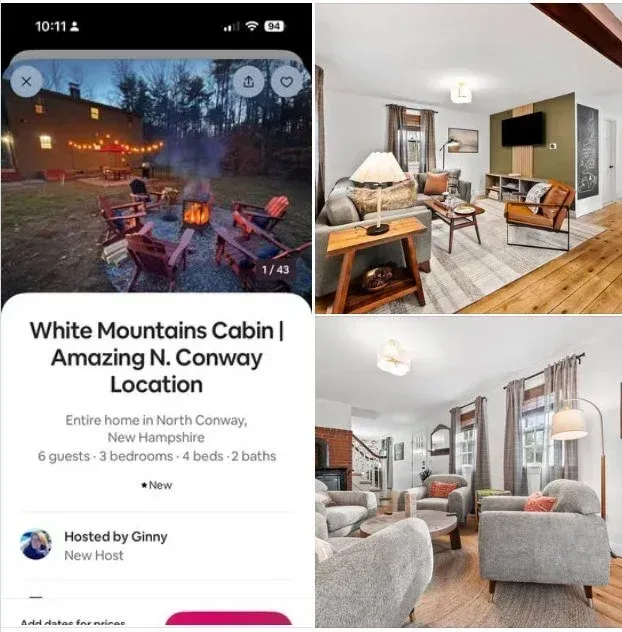
It's job is to stand out on the scroll and speak clearly to the 'emotional' experience guests are seeking.
A host in my public group was asking if a photo of a fire pit is compelling enough. (image attached)
It DOES speak to an 'emotional experience' in terms of inferring relaxed time together, gathering, talking, laughing...prospective guests fill in the dots with their own version of the story in their own mind.
If however, many listings in the location feature fire-pits the image will simply blend in with the crowed. Even the colors in your photo impact on how well it is 'seen' on scroll.
So I always recommend seeing what other listings are leading with BEFORE making your decision.
Then, once you have added the photo, go back to a general search and see how it looks insitu on scroll.
When I did a quick scroll through the location in question, there are VERY few listings leading with the fire pit so it is likely to be quite effective in stopping the scroll in terms of the 'emotional story' it is telling.
Why I Don’t Recommend Responding to Reviews on Your Listing
When it comes to consumer buying behavior, reviews are perceived as independent information. In the online world, they’re often referred to as eWoM—Electronic Word of Mouth.
It’s easy to forget that reviews are is just the digital version of old-fashioned word of mouth. Think about asking a friend or colleague for a recommendation—you want to hear their perspective in an uninterrupted way so you can make your own judgment.
When hosts reply to every review, it can subtly shift how those reviews are perceived. It’s a bit like leaning over someone’s shoulder while they’re talking and adding your own commentary—it interrupts what was meant to be an independent voice.
Some hosts even use AI to respond, repeating key words from the guest’s own review. But when potential guests see the same canned phrasing repeated review after review, it feels inauthentic—and adds no real value.
If you want to thank a guest or acknowledge something they’ve said, that’s far more meaningful in a private message—where it’s personal, not performative.
There’s decades of research into how reviews influence decision-making—stretching back to the 1960s. The principles of word of mouth haven’t changed just because the format has.
The more options someone has, the harder it becomes to choose. Reviews help cut through that by showing how others, just like them, have experienced something.
Reviews, like every part of your listing, have their own job to do. Our role as hosts is to provide our information in the listing itself, then allow other voices to speak without us stepping in.
Research into the “qualitative characteristics of online reviews” shows that depth and subjectivity matter most. A thoughtful, detailed review from a happy guest is valuable both to potential guests AND to the algorithm.
In short: let your reviews stand on their own. They carry more weight—and more authenticity—when they speak for themselves.
P.S. There is one exception to this - if someone posts a review that is dramatically inaccurate, that is the time where a short, professional response is useful. Usually a review like this will stand out in a sea of great reviews as reflective of the guest and not the stay.